
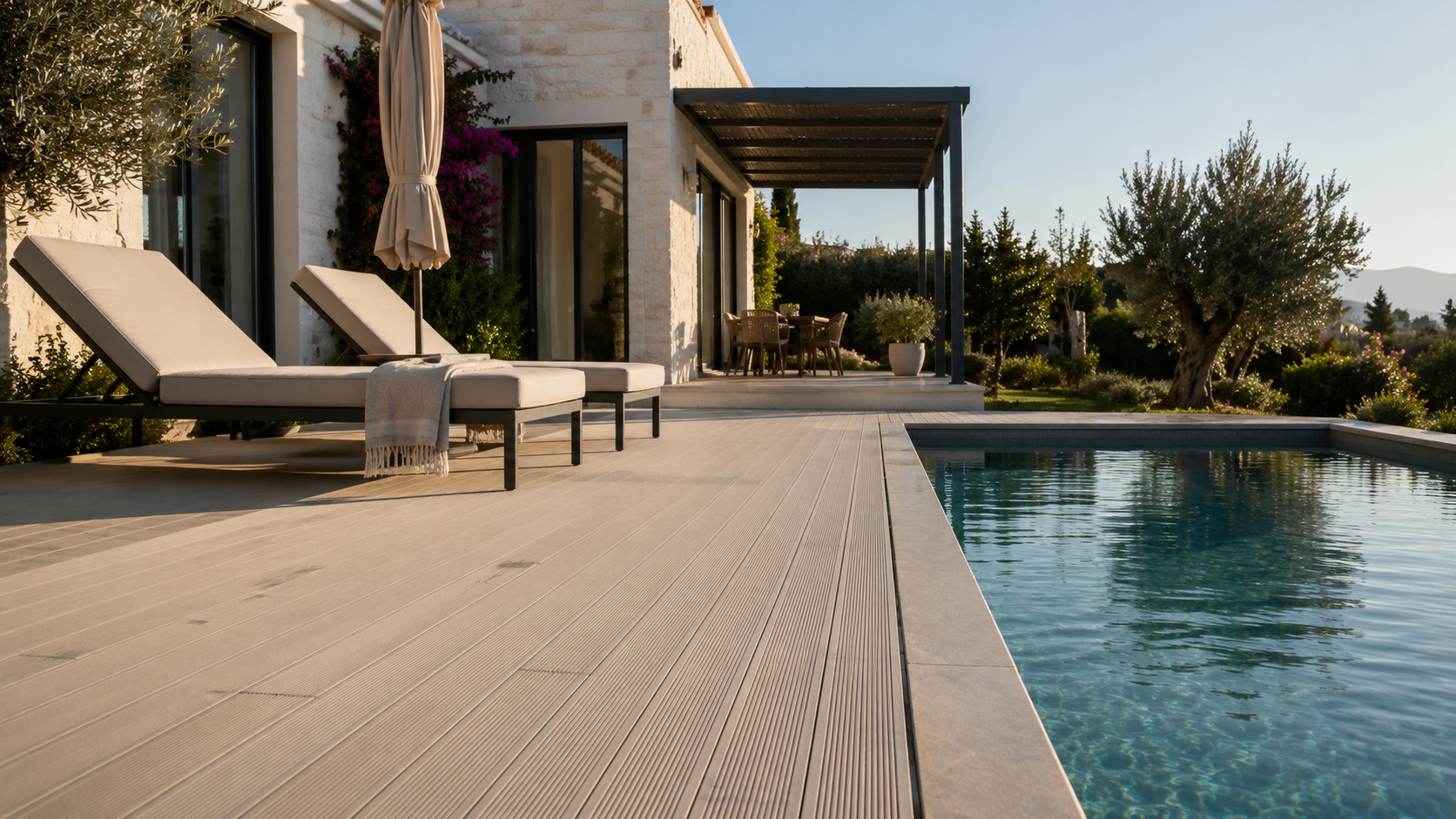
Decking or Tiles Around the Pool? A Guide to Choosing Poolside Flooring in Northern Cyprus
The aesthetic appearance of a pool surround is important. However, choosing the right TRNC poolside flooring affects far more than how the space looks in photographs.
Safe walking with wet feet, barefoot comfort under the sun, proper water drainage, daily cleaning requirements and long-term maintenance are all fundamental parts of this decision.
The straightforward answer is that both decking and ceramic tiles can deliver successful results when used in the right project. There is no single material that is always the best option for every poolside area. The correct choice should be based on the amount of sunlight the area receives, the intensity of use, the condition of the existing surface, the drainage infrastructure and the wet-area performance of the selected product.
Quick Decision Summary
Decking may be preferred when:
- A warmer and more natural appearance is desired.
- Visual continuity is required between the garden, veranda and pergola.
- A resort or beach club atmosphere is being created.
- The existing surface is to be covered using a suitable substructure.
Outdoor ceramic tiles may be preferred when:
- A stone, concrete or mineral appearance is desired.
- Visual continuity is required between the pool coping, steps and overflow channel.
- A technical selection will be made from different surface textures.
- Sharp and modern architectural lines are to be emphasised.
With either option, proper slope, drainage, substrate preparation and professional installation are just as important as the selected material in achieving a safe and long-lasting result.
For this reason, choosing TRNC poolside flooring requires the material and installation details to be considered together.
Why Should Poolside Flooring Be Approached Differently in Cyprus?
Cyprus has a Mediterranean climate characterised by long, dry and sunny summers. According to the official tourism source Visit Cyprus, the average daily duration of bright sunshine reaches 11.5 hours during the six-month summer season.
For this reason, when evaluating poolside flooring solutions in Cyprus, the suitability of TRNC poolside flooring products for prolonged sun exposure and intensive use should be examined separately.
In hotels, residential complexes, beach clubs, restaurants and sports facilities, these conditions are also accompanied by:
- Heavy pedestrian traffic
- The movement of sun loungers and tables
- Service trolleys and equipment
- Regular surface cleaning
- Sunscreen, drink and food stains
- Chlorinated or saltwater pool water
When deciding between decking and ceramic tiles, the following seven criteria should therefore be assessed together.
1. Is the Term “Non-Slip Flooring” Sufficient on Its Own?
No. A surface that provides good grip in dry conditions may not offer the same performance when exposed to pool water and used with bare feet.
The UK Health and Safety Executive, or HSE, states that a large proportion of slip incidents are associated with wet or contaminated floors. It also emphasises that the selected material should be assessed together with the contaminants to which the surface will be exposed and the cleaning methods that will be used.
Terms such as “non-slip,” “textured” or “safe surface” in a product catalogue should not be considered sufficient on their own. Answers should be requested to the following questions:
- Has the slip resistance been tested under wet conditions?
- Was the test conducted for use with footwear or for barefoot use?
- Which standard and test method were used?
- How does the surface perform when exposed to chlorinated or saltwater?
- Can the textured surface be cleaned easily on a daily basis?
- Does the slip resistance change over time and with continued use?
The HSE also recommends that the results of different testing methods be interpreted correctly and that manufacturers’ data be assessed in relation to the intended environment.
Particularly in shared-use areas such as hotels, residential complexes, municipal pools and sports facilities, the technical performance of the selected product should be verified by a specialist in accordance with the project requirements.
To select an appropriate non-slip poolside surface, the test data for TRNC poolside flooring products should be assessed together with the actual installation conditions.
2. How Can Barefoot Comfort Be Achieved Under the Sun?
One of the most frequently overlooked issues around pools in Cyprus is surface temperature.
All outdoor surfaces, including decking, ceramic tiles, stone and concrete, can become hot when exposed to direct sunlight. However, the perceived surface temperature varies depending on:
- The structure of the material
- The colour of the surface
- The texture and type of finish
- The daily duration of sun exposure
- The ventilation of the substructure
- The proportion of the area that is shaded
In general, darker surfaces absorb more solar energy. For this reason, instead of choosing a colour solely under showroom lighting, it is more reliable to evaluate an actual product sample at the intended installation site.
The following questions should be considered during the sample evaluation:
- How many hours of direct sunlight does the pool surround receive each day?
- At what times of day is the area used most intensively?
- Will children or older people use the surface frequently?
- Is shade available around the sun loungers and walking areas?
- Would light-coloured decking or tiles be compatible with the architectural design?
- Can the sample be tested barefoot under real sunlight conditions?
The colour of poolside flooring is not merely a decorative choice. It is also a project decision that directly affects barefoot comfort.
Testing a sample under real conditions can support a more informed TRNC poolside flooring decision.
3. Why Should Drainage Be Planned Before the Surface Material Is Selected?
Selecting a surface material before determining where and how water will be drained can cause problems even when a high-quality product is used.
Water remaining on the surface may:
- Increase the risk of slipping
- Cause dirt and sediment to accumulate
- Increase maintenance requirements at joints and connection points
- Create moisture problems in the substructure or existing surface
- Prevent drains and overflow channels from functioning correctly
For this reason, drainage should be clearly planned before the surface material is selected as part of any TRNC poolside flooring project.
Drainage in Ceramic Tile Systems
With outdoor ceramic tiles, the correct slope, suitable joints, drain connections and pool-edge finishing details must all be planned together so that water can be directed towards the drainage points.
Even if the ceramic tile itself is water-resistant, an incorrect slope or insufficient drainage plan can cause water to collect on the surface.
Drainage in Decking Systems
In decking systems, water generally passes through the gaps between the deck boards and reaches the surface below. The substructure, water drainage, ventilation gaps, joint spacing and pool-edge details must therefore be designed together.
Decking does not automatically resolve drainage problems underneath simply because it covers the existing surface.
When decking is being considered over existing ceramic tiles, the following checks should be carried out first:
- Is there an incorrect or reverse slope in the existing surface?
- Does rainwater or pool water collect in specific areas?
- Are the existing tiles sound and structurally capable of supporting the new system?
- Can access to the drains be maintained?
- Will the height of the decking affect doors or step levels?
- Will the pool’s overflow channel or edge profile be affected?
- Will the subfloor remain accessible for future maintenance?
These checks require professional site inspection and installation planning.
As part of professional outdoor decking installation in the TRNC for pools, gardens, terraces and commercial areas, the existing condition of the site, floor levels and architectural transitions should be assessed before installation.
ROCASSA’s service page includes design consultancy, installation workmanship, fitting, transportation and post-installation quality-control processes.
4. What Is the Visual Difference Between Decking and Ceramic Tiles?
Decking gives a pool surround a warmer, more natural and relaxation-oriented atmosphere.
It can create a particularly strong visual effect in:
- Villas with swimming pools
- Boutique hotels
- Beach club projects
- Pool bars
- Pergola areas
- Garden and veranda transitions
- Outdoor restaurant and café areas
Its timber appearance can soften the transition between indoor and outdoor spaces and reinforce a resort-style atmosphere around the pool.
Outdoor ceramic tiles, on the other hand, highlight the appearance of stone, concrete and mineral surfaces. In projects with modern and sharply defined architectural lines, they can continue the same design language across the pool coping, stairs, wall cladding and overflow channel.
The correct question is therefore not:
“Is decking more attractive than ceramic tiles?”
The correct question is:
“Which flooring system creates the strongest visual continuity with the architectural language, intended use and surrounding materials?”
For poolside decking applications in particular, decking options in the TRNC and composite decking solutions in Cyprus should be compared according to the architectural style and intensity of use.
This prevents the TRNC poolside flooring decision from being based solely on appearance.
5. How Do Cleaning Products and Pool Chemicals Affect the Flooring?
Poolside flooring does not come into contact only with clean water.
The following substances may regularly reach the surface:
- Chlorinated pool water
- Saltwater
- Sunscreen and oils
- Food and drinks
- Soap and shower products
- Algae and organic residue
- Cleaning chemicals
For this reason, the product’s maintenance instructions should always be reviewed when choosing decking or ceramic tiles.
The following information may be requested from the manufacturer or installation company:
- Recommendations regarding exposure to pool chemicals
- Suitable cleaning products
- Chemicals that should be avoided
- Limitations on pressure washing
- Warnings regarding the use of hard brushes
- Recommended stain-removal methods
- Maintenance requirements included in the warranty conditions
The HSE warns that incorrect or inadequate cleaning methods may increase rather than reduce the risk of slipping.
Cleaning should be carried out using products and equipment suitable for the flooring type. Wet areas should be managed carefully, and spilled liquids should be removed promptly.
Safety is therefore not achieved through material selection alone. The facility’s daily cleaning and maintenance routine also affects the performance of the pool surround.
A regular maintenance programme directly affects the performance and service life of TRNC poolside flooring systems.
6. Should a Villa Pool and a Hotel Pool Be Planned in the Same Way?
No. The pool surround of a family villa does not experience the same intensity of use as a hotel, residential complex or beach club pool used by hundreds of people.
Priorities for villas and holiday homes include:
- Barefoot comfort
- Visual compatibility with the garden and veranda
- Easy cleaning
- Low maintenance requirements
- Conditions during the off-season
- Preservation of the existing surface
- Safe movement for children and pets
- The extent to which installation work will disrupt residential use
In these projects, the choice of villa poolside flooring is generally centred on comfort and architectural continuity.
Priorities for hotels, residential complexes and beach clubs include:
- Documented wet-surface performance
- Resistance to heavy pedestrian traffic
- Movement of sun loungers and service equipment
- Fast and regular cleaning
- Drainage capacity
- Accessibility
- The ability to replace damaged sections quickly
- The period during which the business will need to remain closed
- The possibility of dividing the installation into phases
The CDC’s Model Aquatic Health Code guidance classifies hotels and motels, apartment complexes, residential communities, membership clubs and schools among aquatic venues used by the public.
The document is not part of TRNC legislation. However, it is an international good-practice resource demonstrating the importance of considering design, maintenance, operation and user safety together in commercial swimming facilities.
For this reason, decisions concerning hotel poolside flooring or beach club flooring should not be made solely by examining aesthetic samples.
The selection of TRNC poolside flooring for residential and commercial projects should therefore be planned separately according to the intensity of use.
7. Which Factors Affect Poolside Flooring Prices?
A single price per square metre found online may not represent the actual total cost of the project.
Poolside flooring prices may vary according to:
- The net area to be covered
- The selected decking or ceramic tile model
- Whether the existing surface needs to be removed
- Floor correction and levelling requirements
- Slope and drainage adjustments
- The substructure required for decking
- Pool-edge returns and finishing details
- Steps and staircase details
- Drain and overflow-channel modifications
- Connections with doors and façades
- Transportation of materials to the installation area
- Vehicle or equipment access to the site
- Phasing requirements in commercial facilities
- The required completion period
For example, an existing floor that is level, stable and correctly sloped will not have the same installation budget as a broken surface with standing water and level differences.
For accurate pricing, providing only an approximate area in square metres is not sufficient. It is also useful to share:
- Current photographs of the area
- Detailed images of the pool edge
- Approximate measurements
- Door and step locations
- The positions of existing drains
- The intended use of the area
- The estimated number of daily users
- The expected installation date
Decking or Ceramic Tiles? Decision Guide by Application Area
This comparison can be used for an initial assessment. The final decision should be made only after the product sample and the installation area have been evaluated together.
Which Decking Options Are Available from ROCASSA?
Two models are currently listed among ROCASSA’s decking options:
- Classic Wood-Grain Decking
- Arched-Groove Decking
Both products are included in ROCASSA’s exterior flooring category.
ROCASSA also provides professional decking installation services for gardens, terraces, balconies, pergolas, pool surrounds and commercial areas.
The service includes:
- Design and installation consultancy
- Decking installation workmanship
- Transportation
- Fitting and assembly
- Finishing details
- Post-installation quality control
For continuously wet areas such as pool surrounds, the following characteristics of the selected product should be verified separately for the specific project using current technical documentation:
- Slip performance on wet surfaces
- Suitability for barefoot use
- Surface behaviour under direct sunlight
- Compatibility with pool chemicals
- Cleaning methods
- Warranty and maintenance conditions
The fact that a product is included in a “decking” or “outdoor flooring” category does not automatically mean that it will provide the same performance in every pool project.
In professional outdoor flooring applications in the TRNC, TRNC poolside flooring options should be selected by considering the technical documentation and site conditions together.
Frequently Asked Questions
Is decking or ceramic tile more suitable around a swimming pool?
Both materials may be suitable. Decking offers a warmer and more natural atmosphere, while outdoor ceramic tiles support a stone, concrete or mineral appearance.
The correct decision should be based on the area’s sun exposure, intensity of use, drainage conditions, maintenance expectations and the wet-area performance of the selected product.
Does decking become slippery when wet?
The slip performance of a decking surface varies depending on its texture, material composition, maintenance condition and installation environment.
Instead of relying only on the term “non-slip,” the wet-surface and, where possible, barefoot-use test results of the selected product should be examined.
Does composite decking become very hot under the Cyprus sun?
All outdoor surfaces can become hot when exposed to direct sunlight.
The temperature of a decking surface varies according to the product’s composition, colour, texture, duration of sun exposure and the proportion of the area that is shaded.
Particularly when considering darker colours, the sample should be tested under real sunlight conditions before a final decision is made.
Can decking be installed over existing ceramic tiles?
This may be possible in some projects.
However, the stability of the existing surface, slope, areas of standing water, access to drains, door levels and the height required for the decking substructure must be checked beforehand.
Decking does not automatically resolve existing drainage problems underneath it.
What type of drainage is required beneath poolside flooring?
The drainage system should direct water away from doors, walls and circulation areas towards suitable drainage points.
For decking installations, the slope of the subfloor, ventilation, gaps between boards and access to drains should be planned together.
For ceramic tile installations, the slope, joints and drainage details must be coordinated.
Does decking require maintenance?
The level of maintenance depends on the type of decking, its surface texture, the intensity of use and the manufacturer’s instructions.
Regular cleaning, keeping the gaps between boards clear and avoiding unsuitable chemicals may be required.
The exact maintenance programme should be based on the technical documentation for the selected product.
Which type of flooring is more suitable for hotel or residential-complex pools?
For shared-use pools, documented wet-surface performance, resistance to heavy traffic, fast cleaning, drainage, accessibility and the ability to replace damaged sections should be prioritised.
The product should be selected by the project team and installation specialists on the basis of technical data.
What determines the cost of poolside flooring?
The total cost depends on factors including the size of the area, selected material, condition of the existing surface, removal requirements, slope and drainage adjustments, substructure, pool-edge details, stairs, transportation and access to the installation site.
Conclusion: Choose the Usage Scenario First, Then the Material
The decision between decking and ceramic tiles around a swimming pool should not be based solely on appearance or the initial price per square metre.
Decking can be a strong option for villas, hotels, pergolas and beach club projects seeking a warm, natural and resort-style appearance.
Outdoor ceramic tiles may be preferred in projects requiring a stone or mineral appearance, visual continuity with pool-edge elements and a variety of technical surface options.
With either system, a safe and long-lasting result depends on the correct planning of four elements:
- A product suitable for the intended use
- Verified wet-surface performance
- Correct drainage and substrate preparation
- Professional installation
You can share photographs, approximate measurements and the intended use of your pool surround with the ROCASSA team.
With service centres in Kyrenia and Famagusta, ROCASSA provides solutions throughout Northern Cyprus and offers on-site inspection and planning support before installation.
Contact ROCASSA to develop a suitable flooring plan for your hotel, beach club, restaurant, residential complex or commercial facility.