
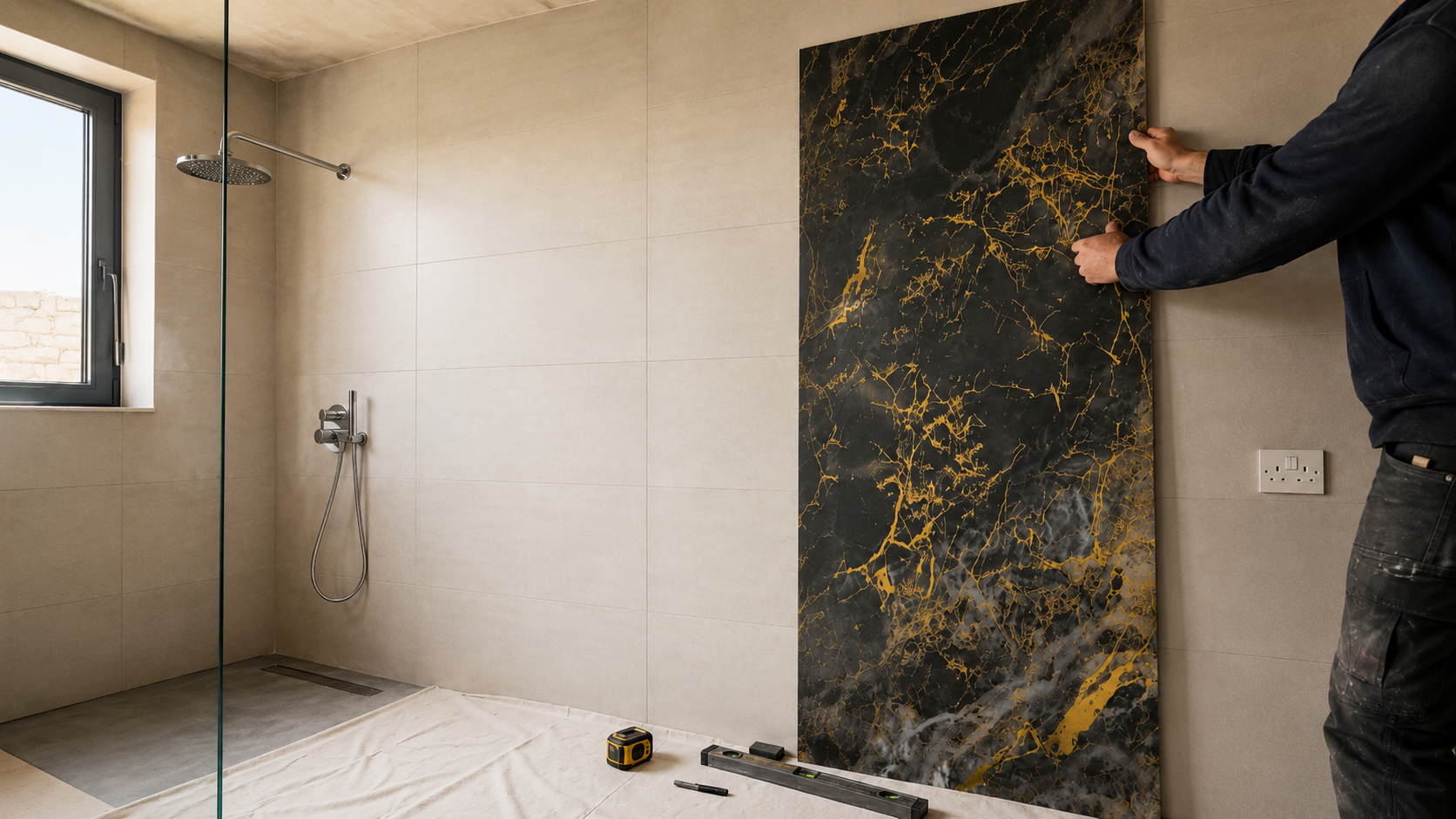
When renovating a bathroom, the first decision that catches the eye is colour; however, the decision that truly determines the outcome is the surface system. Will the existing ceramic tiles be removed? Is the existing wall structurally sound? Where will the water flow in the shower area? How will plumbing penetrations be sealed? How practical will the new surface be for everyday cleaning?
Especially when comparing Northern Cyprus bathroom wall panels with ceramic tiles, looking only at appearance or price per square metre is not enough. The condition of the existing surface, waterproofing, plumbing, intensity of use and installation details should all be evaluated together.
The short answer: Both bathroom wall panels and ceramic tiles can deliver excellent results when used in the right project. If the existing tiles are sound, dry and sufficiently level, and there are no plumbing or waterproofing issues, a panel system may provide a faster visual transformation with less demolition. If the wall needs to be opened, the plumbing replaced, hidden moisture addressed or the underlying structure rebuilt, covering the existing tiles without removing them is not the right approach. In such cases, the underlying problem should be resolved first.
For this reason, there is no single answer to the question wall panels or ceramic tiles for a bathroom that applies to every project. The right choice should be based on the technical condition of the existing bathroom and the way it is used.
The most important point is this: The final surface finish and waterproofing are not the same thing. Do not consider either panels or ceramic tiles alone as the material that “makes the bathroom waterproof.” A reliable wet-area system depends on the substrate, waterproofing, joints, corners, plumbing penetrations, floor-to-wall junctions, falls, drainage and ventilation all working together.
First, Let’s Separate the Concepts: Panels, Ceramic Tiles and Waterproofing
The visible material on a bathroom wall is only the final layer of the system.
On a tiled wall, the tile surface itself may be water-resistant, but grout is not waterproofing. The Tile Council of North America clearly states that in wet areas such as showers, protection must be provided by the installation method and the underlying substrate system.
The same basic principle applies to panel systems. A panel being resistant to water or moisture does not automatically resolve defective plumbing, active leaks, mouldy walls or incorrectly detailed showers. Particularly in SPC wall panels for bathrooms, the panel itself is only one part of the system. The adhesive, corner and edge solutions, silicone or other suitable sealing materials, and plumbing penetrations must also be compatible with the selected system.
For this reason, when requesting a quotation, it is not enough to ask only “which panel?” or “which ceramic tile?” You should also request a written answer to the following question:
“What layers make up the complete system recommended for the shower and wet area?”
Key Differences Between Bathroom Wall Panels and Ceramic Tiles
| Decision criterion | SPC wall panel approach | Ceramic tile approach |
|---|---|---|
Existing surface | If the selected product’s installation instructions permit it, panels may be installed over an existing finish that is sound, dry and level | The existing surface may be removed or, where technically suitable, new tiles may be installed over it; in both cases, load, finished level and adhesion must be checked |
Renovation disruption | If the underlying structure is suitable, demolition, debris and dust may be reduced | If removal is required, more debris and surface preparation may be involved |
Visual effect | Large, continuous surfaces; stone or marble looks can be achieved with fewer visual interruptions | A modular, rhythmic appearance can be created through tile size, laying pattern and grout colour |
Joints | Panel joints, corners, finishing profiles and plumbing openings are critical | Grout joints, corners, movement joints and plumbing penetrations are critical |
Cleaning | Large surfaces can reduce the number of visible joints; connections still require regular inspection | Tile surfaces can be practical to clean; grout cleaning and maintenance requirements vary depending on the material used |
Substrate defects | Hollow tiles, active moisture, unevenness or swelling should not be concealed behind panels | Cracks, unstable substrates or damaged underlying surfaces should be repaired before new tiles are installed |
Repair | Replacing a damaged panel depends on panel size, neighbouring pieces and finishing details | A single tile may sometimes be replaced, provided a matching spare tile is available and the substrate remains sound |
Project duration | If the substrate is ready, installation may progress more quickly in many projects | Removal, plastering, drying, adhesive application and grouting can extend the project duration |
Total cost | Panels, adhesive, profiles, cutting, surface preparation and installation should all be calculated together | Tiles, removal, debris disposal, surface levelling, waterproofing, adhesive, grout and labour should all be calculated together |
Suitability | Written technical confirmation should verify that the product is suitable for bathrooms and areas directly exposed to water | The entire installation system, not only the type of tile, should be verified as suitable for wet areas |
This table provides a general decision framework. A definitive choice cannot be made without evaluating the product, the existing wall and how the bathroom will be used. Therefore, when researching Northern Cyprus bathroom wall panels, you should consider not only product designs but also the technical documentation and the condition of the surface on which the product will be installed.
When Can Panels Be the Stronger Option?
1. When the Existing Ceramic Tiles Are Genuinely Sound
A Northern Cyprus wall panel installation should only be considered when the existing surface is technically suitable. The statement “it can be installed over existing tiles” is not enough on its own. The existing finish should first be checked:
- Is there a hollow sound when the wall tiles are tapped?
- Are there any moving, cracked or swollen tiles or grout joints?
- Is there any suspicion of an active water leak behind the wall?
- Are there signs of mould, salt deposits or persistent moisture?
- Is the wall sufficiently level?
- Will the thickness of the new finish cause problems around door trims, taps, shower screens, washbasins or furniture connections?
If any of these checks produces an unfavourable result, the problem should not simply be covered with panels. The cause should first be identified, the damaged section opened where necessary and the issue repaired appropriately.
Likewise, if SPC panels over ceramic tiles are being considered, the load-bearing condition of the existing tiles, the flatness of the surface and the panel manufacturer’s installation instructions should all be checked together.
2. When You Want to Reduce Demolition, Debris and Business Downtime
The amount of time a bathroom remains out of use can have a direct financial impact, particularly in rental villas, boutique hotels, aparthotels, restaurant staff bathrooms and other heavily used commercial spaces. If the underlying infrastructure does not need to be changed, panel installation may offer a more controlled and less dusty renovation process than removing ceramic tiles.
For this reason, bathroom renovation without demolition can offer a significant advantage in projects where the existing infrastructure is suitable for retention. However, this does not mean that a problematic wall can simply be covered without inspection.
The statement “panels are faster” is also not a fixed promise for every bathroom. If plumbing, the shower tray, floor falls, cabinetry, electrical installations or ventilation need to be changed, the project becomes more than a surface-finishing job.
3. When a Large, Continuous Stone Look Is Desired
Large-format panels can display marble or stone veining without dividing the pattern into numerous smaller sections. This may be an important advantage for those who want to create a calmer visual effect in small bathrooms, establish a consistent visual language across hotel bathrooms or design the washbasin and shower wall as one continuous composition.
Particularly in modern bathroom wall covering projects, large-format surfaces can create a more cohesive and less visually fragmented design language.
Pattern placement should not be left to chance. Before installation, the panel cutting plan should account for the main veining, corner transitions, niches, tap positions and washbasin alignment.
4. When Fewer Visible Joints Are Preferred
Panels can reduce the number of visible joints, but this does not mean they are completely “joint-free” or “maintenance-free.” Panel connections, internal and external corners, floor-to-wall lines, shower screen connections and plumbing penetrations still need to be detailed correctly and inspected regularly.
When Can Ceramic Tiles Be the Stronger Option?
1. When the Wall Will Already Be Opened
If old plumbing is being replaced, a hidden leak needs to be investigated or the waterproofing system will be completely rebuilt, preserving the existing tiles is no longer the main priority. Opening the wall, correcting the substrate and constructing a new system from scratch may be the more appropriate approach.
2. When a Modular Design Is Desired
Small-format tiles, mosaics, different laying directions and grout colours can be used to create more dynamic designs. In bathrooms with arches, niches, curves or numerous narrow surfaces, modular pieces can provide greater design flexibility.
3. When Localised Repair Is a Priority
If spare tiles have been retained and the underlying structure has not been damaged, it may be possible to replace a single tile after localised damage. With a large panel, the repair area may be larger. However, the future availability of the same product should never be assumed with either system, so an appropriate quantity of spare material should be stored after the project is completed.
4. When a Traditional Ceramic Tile Appearance Is Specifically Desired
Ceramic tiles are not only a technical choice but also an aesthetic one. If the desired design includes a handmade surface feel, a clearly visible grout rhythm, mosaics or a traditional Mediterranean style, the right ceramic tile system can deliver a strong result.
Is Bathroom Renovation Without Demolition Possible in Every Bathroom?
No. “Renovation without demolition” is a genuine advantage only in projects where the existing infrastructure is suitable for retention; it is not a universal solution for every problematic bathroom.
Professional inspection is recommended before covering the surface in the following situations:
- Recurring mould or damp
- Moisture marks on the opposite side of the wall
- Water leaking into the floor below or an adjoining room after showering
- Hollow, loose or cracked ceramic tiles
- Swollen cabinet units or damaged skirting
- Unpleasant odours, slow drainage or overflowing drains
- Water pooling on the shower floor
- Loose taps, plumbing escutcheons or shower screen fittings
- Electrical points positioned inappropriately close to wet areas
Active leaks, electrical safety issues, waterproofing and plumbing work are not suitable for DIY experimentation. They should be inspected by a qualified professional.
What Should You Consider Locally When Choosing Bathroom Materials in Northern Cyprus?
In Northern Cyprus, choosing Northern Cyprus bathroom wall panels or ceramic tiles should not be based solely on summer temperatures. Air-conditioning use, properties that remain closed for long periods, long showers, inadequate extraction and periods of intensive occupancy can all increase indoor moisture levels. Particularly in holiday homes that remain empty for part of the year and short-term rental villas, ventilation and leak control can be just as important as the finishing material itself.
From this perspective, when evaluating Cyprus bathroom wall panels, you should consider not only the product’s appearance but also how often the bathroom will be used, the ventilation conditions and which areas are directly exposed to water.
The U.S. Environmental Protection Agency (EPA) states that good ventilation is important for removing unwanted moisture from bathrooms and that recurring mould should be controlled by addressing the source of water and moisture, rather than relying only on surface cleaning.
For this reason, the following points should be assessed during the site survey:
Ventilation
- Is there sufficient window ventilation or mechanical extraction?
- Does the extractor fan actually discharge air outdoors?
- Is there enough air circulation to allow surfaces to dry after showering?
- Does condensation occur in the bathroom while air conditioning is being used?
Water Management
- Does shower water flow properly towards the drain?
- Does water escape beyond the shower screen?
- Are floor-to-wall junctions sound?
- Are taps, shower heads, niches and pipe penetrations properly sealed?
If a shower wall panel is to be used in an area directly exposed to water, the suitability of both the panel surface and the complete joint and installation system for that application should be verified.
Daily Use
- Is the bathroom in a private home, hotel or rental villa?
- How many cleaning cycles take place each day?
- Are strong or abrasive cleaning chemicals used?
- Is there a risk of impact from guest luggage, cleaning trolleys or equipment?
- How long can the room or property reasonably remain out of use in the event of a repair?
The right product should be selected according to the actual use scenario. Therefore, when choosing from general Cyprus wall panel options, the product’s specific technical suitability for bathrooms and wet areas should also be confirmed.
How Can Panel and Ceramic Tile Prices Be Compared Fairly?
Comparing only the price per square metre can be misleading. Compare both quotations based on the same project scope.
A Panel Quotation Should Include
- Full product name and code
- Confirmation of technical suitability for the bathroom and selected wet area
- Net area and order quantity
- Pattern matching and cutting plan
- Existing surface inspection and any necessary corrections
- Adhesive or installation system
- Internal/external corner and finishing profiles
- Silicone or other sealing details
- Cut-outs for taps, sockets, switches, niches and other penetrations
- Shower screen, washbasin and furniture connections
- Delivery, handling, installation and cleaning
- Warranty coverage and exclusions
A Ceramic Tile Quotation Should Include
- Full tile range, dimensions and finish
- Removal and disposal of debris
- Substrate repair and levelling
- Required waterproofing system
- Adhesive, grout and flexible joint materials
- Corner, niche and plumbing cut-outs
- Net area, waste allowance and spare materials
- Delivery, handling, installation and cleaning
- Drying and return-to-use schedule
- Warranty coverage and exclusions
The lowest material price does not always result in the lowest completed project cost. Removal, surface correction, plumbing and waterproofing can significantly affect the total. For this reason, quotations for a Northern Cyprus bathroom renovation should be checked to ensure they include the same scope of work.
Does the Decision Change for Homes, Rental Villas and Hotels?
Yes. The same bathroom can have different priorities depending on how it is used.
Permanently Occupied Home
Priorities include everyday comfort, personal design preferences, long-term maintenance and future access to plumbing. Material selection should also take the homeowner’s cleaning habits into account.
Short-Term Rental Villa
Fast room turnover, simple cleaning instructions, impact risk, spare materials and a repair-service plan become more important. The chosen system should not only look good but also be something the property’s cleaning team can maintain correctly.
Hotel and Aparthotel
Repeatable detailing, room-by-room installation planning, business downtime, technical documentation, compatibility with cleaning chemicals, fire requirements and project-specific regulations should each be verified separately. A product considered suitable for residential use should not automatically be transferred to a commercial project without appropriate technical documentation and project approval.
The Most Practical Decision-Making Method: Four Steps
1. Discuss the Problem Before the Surface Finish
When planning floor and bathroom renovation in Northern Cyprus, address leaks, damp, floor falls, ventilation and plumbing problems before selecting the final surface.
2. Separate the Usage Zones
The wall directly exposed to shower water, the area behind the washbasin, the toilet area and walls exposed only to humidity do not operate under the same conditions. Confirm the product’s suitability for each zone separately.
3. Obtain Two Complete System Quotations
Compare panels and ceramic tiles not only by material price, but by the total cost of a completed, cleaned and ready-to-use project.
4. View the Sample in the Actual Lighting
Do not choose stone- or marble-effect surfaces based only on a phone screen. Select a sample from the SPC wall panel collection and evaluate it in the bathroom during both daytime and evening lighting, alongside the cabinetry, countertop, fittings and flooring.
12 Critical Questions to Ask Before Requesting a Quotation
- What is the exact name and product code of the recommended material?
- Is the product officially documented as suitable for shower walls directly exposed to water?
- How will the existing ceramic tiles and wall be inspected?
- How will the process change if active moisture, mould or a water leak is discovered?
- Where does waterproofing sit within this quotation, and which areas does it cover?
- How will internal corners, external corners and panel joints be finished?
- How will taps, pipes, niches and shower screen penetrations be made watertight?
- Who will check the floor-to-wall junctions and shower falls?
- Will the thickness of the new surface create problems around doors, washbasins or furniture?
- Are demolition, debris removal, delivery, handling and cleaning included in the price?
- What is the estimated period during which the bathroom will remain out of use?
- What is covered by the written product and installation warranty?
When obtaining prices from local teams for Kyrenia bathroom renovation and Famagusta bathroom renovation projects, asking for the survey, delivery, surface preparation and installation scopes to be listed separately can make quotations easier to compare.
Frequently Asked Questions
Can Bathroom Wall Panels Be Installed Over Existing Tiles?
Some panel systems can be installed over existing ceramic tiles if the product instructions permit it and the current surface is sound, dry, clean and sufficiently level. If there are hollow tiles, active leaks, mould, damp or significant surface irregularities, the surface should not simply be covered. The decision should be made after an on-site survey.
Do SPC Wall Panels Make a Bathroom Completely Waterproof?
No final surface material should be considered the entire waterproofing system on its own. A panel surface may be water-resistant, but water problems can still occur if corners, joints, plumbing penetrations, floor-to-wall junctions and the underlying system are not detailed correctly.
Are Panels Faster to Install Than Ceramic Tiles?
If the existing surface is suitable and the plumbing will not be changed, panels may be installed more quickly and with less disruption than a ceramic tile system that requires demolition. However, in projects requiring leak repairs, waterproofing, floor-fall corrections or plumbing replacement, the project duration is determined more by the underlying work than by the final surface material.
Are There No Joints at All with Panels?
Large panels can reduce the number of visible joints, but there are still panel connections, corners, finishing edges and plumbing penetrations. These details must be completed using appropriate system components.
Can a Mouldy Wall Simply Be Covered with Panels?
No. Covering the surface without identifying the source of the mould or damp can conceal the problem. Any leak, condensation or ventilation issue should first be addressed, and the damaged area should then be dried and repaired using an appropriate method.
How Should Panel Surfaces Be Cleaned?
The maintenance instructions for the selected product should be followed. Abrasive sponges, strong solvents or concentrated chemicals should not be used unless approved by the manufacturer. In hotels and rental villas, it can be helpful to provide cleaning staff with a written maintenance procedure that is compatible with the product.
Can Every SPC Panel Be Used in a Shower Area?
No. The term “SPC” alone does not mean that a product is suitable for shower use. The suitability of the exact product code, panel, adhesive, joint system and finishing system for areas directly exposed to water should be confirmed through written technical documentation.
Conclusion: The Best Surface Is One That Does Not Hide the Problem Beneath It
There is no universal winner between bathroom wall panels and ceramic tiles.
On a sound substrate, when less demolition and a contemporary large-format appearance are desired, Northern Cyprus bathroom wall panel solutions can be a strong option. If the wall needs to be opened, the plumbing and waterproofing need to be rebuilt, or a modular ceramic tile design is specifically preferred, ceramic tiles may be the more appropriate solution. In some projects, using the two materials in different zones may provide the most balanced result.
Make the decision based on the actual condition of the bathroom before relying on catalogue images. ROCASSA’s official Northern Cyprus Bathroom Renovation service lists project-specific design and installation consultancy, wall panel and flooring installation, preparation for washbasins, showers and furniture, silicone/grout/finishing details, delivery, quality control and handover-ready presentation among its services.
To evaluate panel and ceramic tile options for your bathroom within the same project scope, schedule a free site survey with ROCASSA and request recommendations from its Famagusta-based team based on the existing surface, usage scenario and finishing details. Particularly when comparing Northern Cyprus bathroom wall panel alternatives with ceramic tiles, reviewing two complete system quotations prepared according to the findings of the site survey can help you make a more informed decision.
SOURCES
- https://rocassa.com/
- https://rocassa.com/hizmetler/kktc-banyo-tadilat
- https://rocassa.com/hizmetler/kktc-duvar-paneli
- https://rocassa.com/urunler/spc-duvar-paneli
- https://rocassa.com/blog
- https://www.instagram.com/rocassa.cyprus/
- https://www.instagram.com/reel/DZ9j265sY37/
- https://tcnatile.com/resource-center/faq/ceramic-tile/
- https://www.epa.gov/indoor-air-quality-iaq/remodeling-your-home-and-indoor-air-quality
- https://www.epa.gov/mold/brief-guide-mold-moisture-and-your-home